We closed the rotor tip. The evidence loop is still open.
A quadrotor prop with no blade tips: what the Poltergeist toroidal rotor program produced when every number had to survive its own audit.
Every propeller ends the same way: a blade tip, a tip vortex, and a slice of your battery converted into noise. A toroidal rotor refuses to end — each blade folds over and rejoins the hub, so there is no free tip to shed from. The claimed prizes are quieter operation and a shape that shrugs off contact, which matters a great deal on a sub-250 g quad that lives near walls, floors, and occasionally furniture.
So we designed one: an 88.9 mm (3.5 in) 3-D-printable smooth-tip toroidal rotor for Poltergeist, judged at a frozen comparison point — the HQProp T3.5×2×3 on its bench motor at 24,486 RPM, which sets a measured necessary-condition bar of 2.8613 N.

The candidate mounted ×4 in the Poltergeist studio — 189.7 g all-up, and the rotor verdict lens honestly red: “thrust unscreened.”
This post is the tour. The full story, with every derivation and its provenance, is in the paper: Design and evidence-gated refinement of a 3-D-printable smooth-tip toroidal rotor (also available there as a 53-page PDF).
The most interesting result is a rejection
Early in the program, exact-geometry simulation handed us a gift: 4.089 N of thrust — 143% of the commercial bar — repeatable and bit-identical across reruns. A program that wanted to believe would have led with that number.
Instead the preregistered wake ladder measured the same rotor as its wake was allowed to develop:
| Wake duration | Trailing-mean thrust |
|---|---|
| first instant (t ≈ 0) | 4.089 N |
| 0.24 revolution | 3.728 N |
| 0.50 revolution | 2.988 N |
| 1.00 revolution | 2.008 N |
| 2.00 revolutions | 1.178 N |
Every longer window is lower. The 4.089 N “breakthrough” was a cold-start transient — the aerodynamic equivalent of reading your sprint speed off the first stride — and all five values were rejected as thrust evidence.
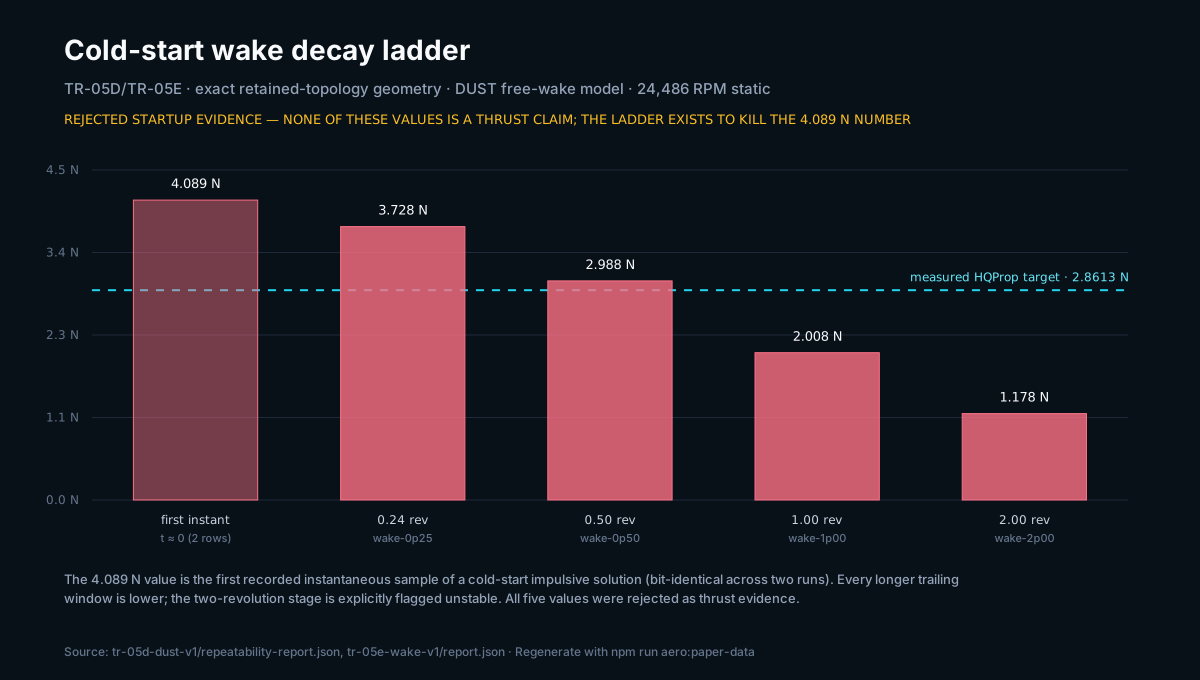
The wake ladder that killed the apparent breakthrough.
That rejection set the tone for everything after it. A preregistered 3,600-cell sectional-CFD campaign was likewise shut down when its pilots admitted zero usable coefficients and its measured wall times extrapolated to 12.6–26.1 serial days; the budget went to bounded geometry batches with promotion rules written down before the results came in.
The screening winner is not the winner
The batches screen candidates on short two-revolution simulations, then promote finalists to four revolutions, where the wake is mature. Inside batch TR-06I the screen leader posted 2.948 N — and then lost at four revolutions, 2.428 N to the eventual winner’s 2.441 N. The order reversed as the wake developed.
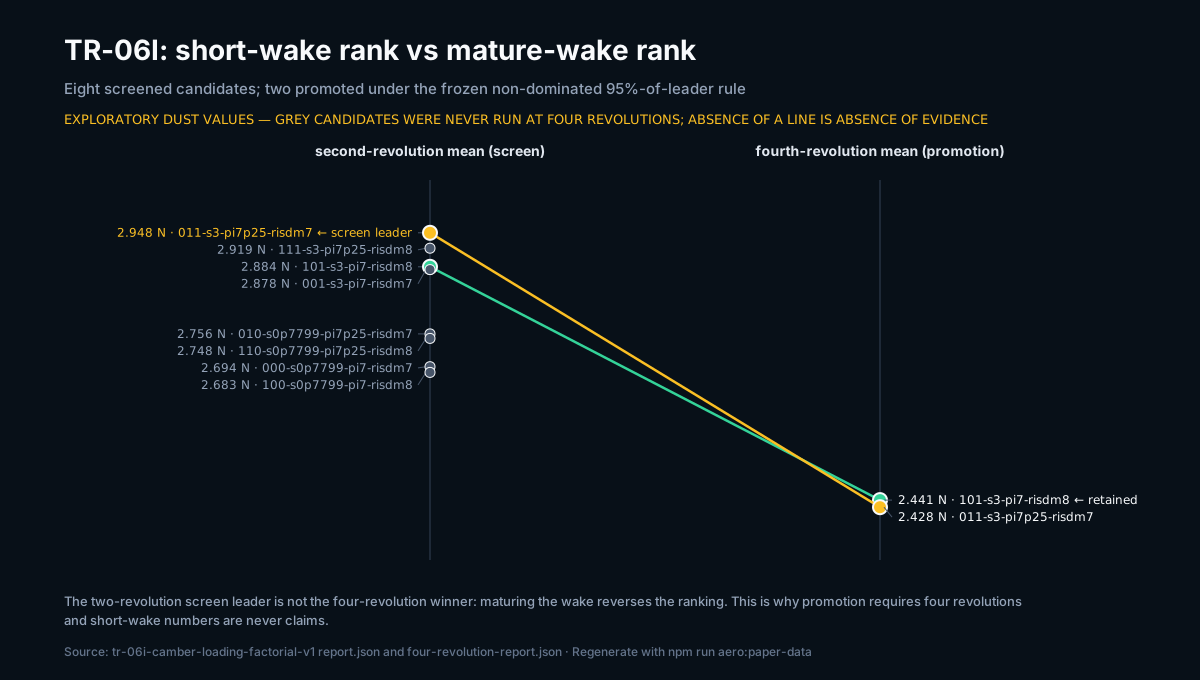
The promotion-window reversal: a young wake flatters the wrong candidate.
This is why the program never compares numbers across windows: a one-revolution figure, a two-revolution figure, and a four-revolution figure are three different instruments pointed at the same rotor.
Explore every candidate
Ninety-five candidate evaluations across nine screening batches and seven promotion rounds, each an exact-geometry unsteady free-wake simulation. Hover or tap any point; the three windows deliberately never share an axis. The double-ring marker is the retained rotor, and the numbered markers are bit-identical replicated anchors — the same geometry re-simulated across batches as a drift check.
services/fea/toroidal-optimization/, commit
de549e2). Explicit simulation failures stay in each batch’s denominator; the
two batches shown short of eight candidates are short because two runs failed,
and hiding that would be a lie of omission.Where it landed
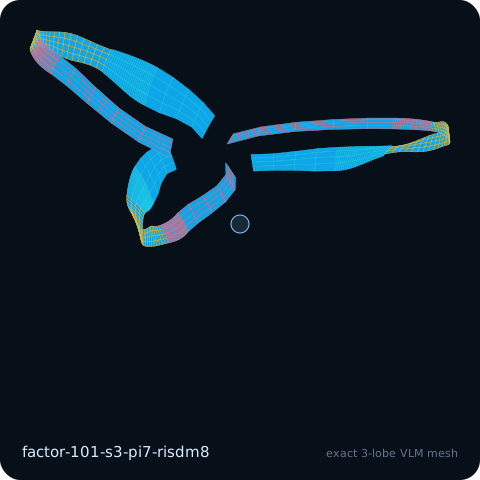
The retained candidate’s exact vortex-lattice mesh — the actual geometry every promotion number was computed on.
The retained rotor, factor-101-s3-pi7-risdm8, improved four-revolution
thrust +6.4% over the prior baseline — at +14.9% more shaft power, so
thrust-per-watt actually fell 7.4%. It reaches 85.3% of the commercial bar.
And the full wake-convergence gate, the standard that would make these numbers
admissible as performance claims, never passed — for any candidate, ever.
So the paper does not claim a rotor that beats a $3 injection-molded prop. It
claims something rarer in optimization write-ups: a reproducible diagnostic
improvement, its exact costs, and a precise accounting of the evidence still
missing. The retained candidate ships with the evidence level
exploratory-non-admissible stamped on it, because that is what it is.
Read the paper
The full report holds the derivations, the failure ledger, all fourteen figures, and the provenance of every number — or grab the 53-page PDF directly. What would change the conclusions: a candidate that passes the mature-wake gate, or a bench test. Both are on the roadmap; neither gets claimed before it happens.